Howl's Moving Castle
The Cat in the Hat
Green Eggs and Ham
Hatchet
Matilda
The Magician's Nephew
Hamlet
The Lord of the Rings
The Importance of Being Earnest
The Complete Little House Nine-Book Set
The Once and Future King
Flame Of Recca, Volume 1 (Flame of Recca
The Return of the King
The Two Towers
Signet Classics The Inferno
Picture of Dorian Gray
The Book Thief
The Other Boleyn Girl
The Hangman's Daughter
Alice I Have Been
}

Saturday, April 30, 2011

Books #14-#25 The Sookie Stackhouse Series

This is actually the reason I've been slacking on posting. A couple of my friends got me into reading this series by Charlaine Harris, and now I'm hooked. They're very easy to read and quick, and I felt like it would be much simpler and more effective if I just waited to write reviews of everything until I finished reading the 12 books that are currently available (I'm counting the collection of short stories as well). So, here goes...

Normally I'm not a reader of series books (at least not as an adult) because the character development feels so shallow and the plot monotonous. I was pleasantly surprised by these books. While the plots still aren't the deepest and the characters do change slowly throughout the series, I still like them! The plot is original, there's an ever-growing amount of supernatural races, and the love stories are constantly fluctuating. It's hard not to like the main character, Sookie Stackhouse. She's funny, she's tough, and she's also very real.

One thing I feel this series has for people who hate reading series books is the definite ending at the end of each volume. You can (and if you're like me, will want to) go straight into the next book, but if you don't, you're not left with a cliffhanger. Things do get reexplained quite often from book to book, but it seems to be a little less with each book, as I suppose Harris assumes that if you're on book 11, you've probably read and know a lot of the other books.

Overall, these are light books but incredibly fun reading. If you're looking for something easy to fill your summer, these are the books for you!

Tuesday, March 22, 2011

Book #13 Sickened by Julie Gregory

So, I haven't posted in ages, but it's not because I haven't been reading! I read this over Spring Break a couple of weeks ago. This book is about a woman who grew up dealing with Munchausen Syndrome by Proxy. If you're not familiar with what this is, here is a basic definition: "a form of child abuse in which a parent induces real or apparent symptoms of a disease in a child."

For this woman, her mother was insistent on her having a heart problem. She malnourished her daughter and caused her to have minor health issues that she blew into major health problems. Her mother also did this to Julie's brother and foster children that she managed to get into her home.

I think the thing that struck me most about Gregory's experience was that what her mother did affected her life as an adult even after she managed to escape. At one point in the memoir, Julie talks about how her mother mixed up a box of cake batter and told her to eat it with a spoon for dinner while she watched tv. Yeah. Later, when Julie is out on her own, she has no idea how to feed herself, and actually continues this strange dinner ritual because she doesn't know any better.

This was an incredibly interesting story, and I would highly recommend this book to anyone who is interested in people who have suffered various types of child abuse, or if you just want something that seems so crazy it's hard to believe.

Saturday, March 5, 2011

Book #11: Torn and Book #12 Ascend by Amanda Hocking

I'm making a double post since these are the other two books in the Trylle Trilogy by Amanda Hocking. The first was Ascend, which I reviewed as book #9 below.

I have to say, this trilogy got better and better the further I read. Wendy, the heroine, gets stronger and more independent. The obvious choice is rarely the one that writer, Amanda Hocking, makes, which is delightful in any fiction, but especially in girls' YA fiction. She doesn't spend the books mooning over the same boy, and very often pushes love out of her mind for the betterment of the Trylle kingdom.

I hesitate to give details because I don't want to ruin the wonderful surprises for future readers, but this whole trilogy was a 5 star absolute must-read!

Wednesday, March 2, 2011

Book #10 Fellowship of the Ring by J.R.R. Tolkien


I have to say, I've read this before, and I'm a huge fan of the movies. I actually took a class in college comparing aspects of LotR to the Bible. Interesting stuff. I have been dying to reread it, so all I needed was a little motivation (thank you to my Goodreads group, "Reading the Chunksters").

I snagged this part right out of one of my old papers, which were based on the film versions. The question I was supposed to answer was about who I believed the three main characters are in the story:

"The three main characters in The Lord of the Rings: The Fellowship of the Ring are Frodo, Aragorn, and the ring itself. Frodo represents innocence. When he is first introduced to the ring, he knows nothing about it. He just finds it on the floor and picks it up, so it has no real power over him. Gandalf tries to maintain some of that innocence by not telling him what it is at first and simply telling him not to put it on and keep it out of sight. Then as Frodo begins to learn the powers of the ring, he becomes a bit more consumed by it. When he first puts it on and becomes invisible, he is less innocent, and becomes more possessed by the ring and its power. He begins to hold onto it more carefully and use the invisibility to his advantage. After the private council in Rivendell, he is even more aware of the power that the ring possesses. As a result near the end of the movie when Aragorn tries to come near to talk to him after Boromir has tried to take the ring, Frodo is panicky and tells him he cannot have it. The more his innocence is destroyed, the more power the ring has over him.

Aragorn represents willpower. He is an ancestor of Isildur, who when given the chance did not destroy the ring. Aragorn seems burdened by this mistake. Though men are the weakest at resisting the power of the ring, he resists with no problem it appears. Aragorn does not want to carry on the same mistake that his ancestor made. He wants to be a part of destroying the evil that follows the ring wherever it goes. At the council Boromir makes a move to take the ring, but Aragorn never moves. He seems completely unaffected by it, when really he is working hard not to give into the evil. Another example is when Frodo is running from Boromir, and Aragorn finds him alone. Frodo thinks that Aragorn is reaching to take the ring from him as he talks, but Aragorn just clenches Frodo’s had tight around the ring, as though he were telling Frodo to keep it safe. He shows enormous willpower in this way because while the ring does tempt him, he does not allow himself to give into it.

The last main character is the ring itself. The ring represents greed. The characters can feel the power that it holds, and it makes them want it for themselves. Isildur refuses to destroy it when he cuts the Dark Lord’s finger off. Smeagol is so completely consumed by it that he follows the fellowship wherever it goes to try and steal the ring back. Bilbo, even after being separated from it for some time, turns into a monster-like creature and tries to snatch it when he sees it on the chain around Frodo’s neck. Boromir is tempted by the power and tries to attack Frodo and take it away. The spirit of the Dark Lord within it makes the characters want it. Anyone who has the ring seems to feel the constant need to see it and touch it, taking comfort in the fact that they have it. The ring even tries to put itself on Frodo’s finger when he, Sam, Pippin, and Merry are hiding from the Black Rider. It has its own mind and its own story, which is what the opening of the films shows. It tells the journey of the ring and establishes it as a character, not just an important object."

I still feel like this is mostly true, although I'm not necessarily sure that the ring has quite as strong a "personality" in the book.

I also feel in reading Fellowship again that it has to end the way that it does, even though it feels abrupt. It shows that the ring bearer, Frodo, is the only one who can destroy the ring. The rest of the fellowship may help him with the fighting and give him moral support, but in the end, Frodo is the one who will have to make that choice and let go of the ring.

Again, I really love this book, though the second volume tends to be my favorite. :)

Sunday, February 27, 2011

Book #9 Switched by Amanda Hocking

What can I say? I'm on a roll. I needed something a little lighter after my run of classics, so I went for a YA fantasy novel that I downloaded for Kindle for 99 cents. That was money well spent. Switched is about a girl, Wendy, whose mother tried to kill her on her sixth birthday because she believed Wendy was not really her child. Eleven years later, with her mother in a mental hospital and under the care of her older brother and aunt, Wendy finds out she was right.

Wendy is a troll. And I think her reaction to finding out is pretty priceless: "Nothing about me resembled a pink-haired doll with a crystal in its stomach or a creepy little monster that lived under a bridge. Admittedly, I was kind of short, but Finn was at least six feet tall."

That's as much as I'm giving away. It falls somewhere on the drama-o-meter beneath
The Twilight Saga, and I can't quite think of a book to go below it at the moment. It's a lot of fun, drama, and romance, and it was good enough for me to immediately buy the second book in the trilogy, Torn, immediately upon finishing it. Enjoy, fellow YA fiction lovers!

P.S. Amanda Hocking also has a blog! Check it out here.

Thursday, February 24, 2011

Book #8 The Strange Case of Dr. Jekyll and Mr. Hyde by Robert Louis Stevenson

I was in classics mode after reading Dracula and Pride and Prejudice, so I dove right into another -- The Strange Case of Dr. Jekyll and Mr. Hyde. I originally became interested in this book because of The League of Extraordinary Gentlemen, the movie. At the time when I first saw the movie, the only characters I was familiar with were Dorian Gray and Tom Sawyer. I became fascinated by the literary connections and began searching for more of the novel referenced. Now, I am nearly done with my quest, and plan to read the last two: Twenty Thousand Leagues Under the Sea and The Invisible Man at some point during this year.

As for the book at hand, this was easily the fastest read for me so far this year. The basic story was as I knew it, but I felt that the message behind it was deeper than I expected. The story is all about capturing the two sides of an individual, the good and the bad. In the case of Dr. Jekyll, he manages to harness the bad and is consumed by it.

To me, that reeked of the essence of teenage rebellion. We all do it to some degree. We look for that little bit of bad to make ourselves feel free and in control and released from our parents. And then there's some point after that in which we realize that we're out of control and trapped in a different way -- in our need to be bad. Fortunately for most of us, we are able to come back from that with a little effort, but poor Dr. Jekyll succumbs to it and is lost forever. That happens to some too. I see it all the time at school. That kid that's hiding behind the bad he or she has become -- if you really look, you can see that it's not really where they want to be.

I think this story won me over more in lesson than in actual story. Good job for making me think, Robert Louis Stevenson. I commend you.

Wednesday, February 23, 2011

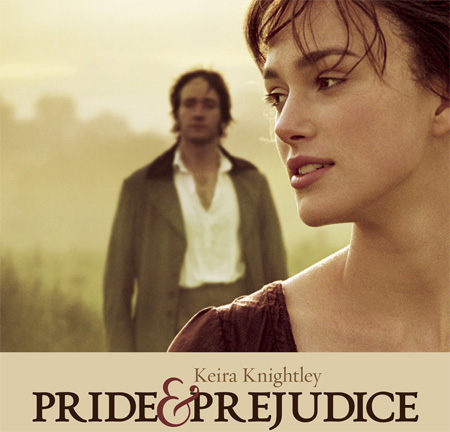
Book #7: Pride and Prejudice by Jane Austen

I am somewhat ashamed to say that this is not only my first time reading Pride and Prejudice, but also my first time reading Jane Austen. Oh, Jane! Where have you been all my life? I adored it. My friends had all given it such good reviews that I was afraid I would be disappointed. On the contrary, I think I'll pick up more Jane Austen very soon.

I was enthralled with the characters, especially since the descriptions of them are so, well...unhelpful. That seems contradictory, but let me explain what I mean. Too often an author gives away too much in a character description. They tell us what the characters look like, how they act, and all of what they are thinking. In essence, they tell us what they think of their characters and what they intend for us to think. I spent a large portion of this book making up my mind about characters, and often I found myself making discoveries about them at the same time as Elizabeth Bennett.

I also enjoyed having my own mental images of characters rather than being told explicitly what they looked like. It made it much less disappointing to watch a movie (which I did immediately upon finishing the book) that didn't necessarily portray characters the way I had created them myself. Some books that give a lot of description, like Twilight, make the cast of a movie so darn disappointing. Sorry, Robert Pattinson, I really had a better looking Edward in my mind.

I also thoroughly enjoyed the large amount of dialogue. I got a lot more caught up in the story because I had to pay attention to what was said, sort of like watching an episode of Gilmore Girls, which I also love. The love story was breathtaking, and I can now see why so many girls want to be Elizabeth Bennett and find their own dashing Mr. Darcy. It felt real and unplanned and so wonderful. This is my second classic of the year, and I think it may be tied for my favorite classic of all time!